

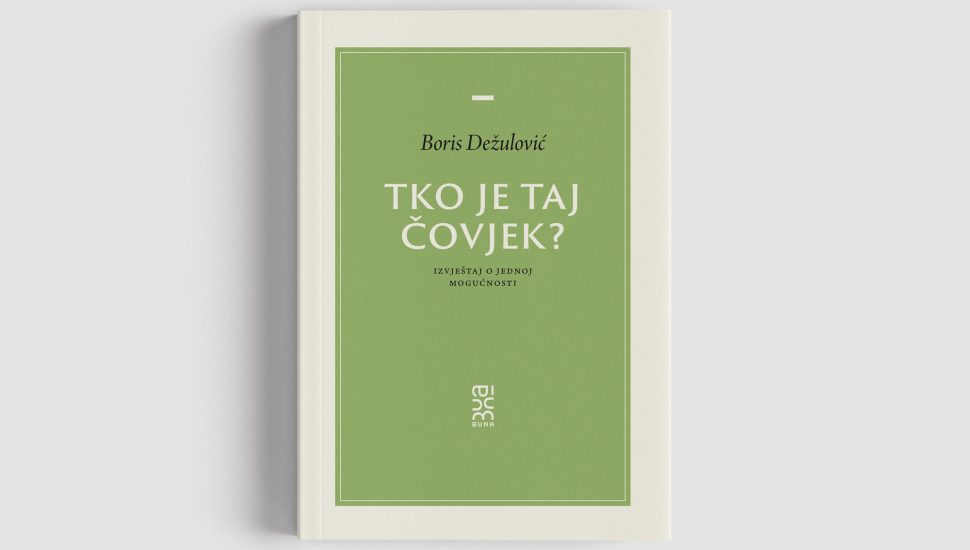
In the "Ivo Andrić" Book Club, on Wednesday (July 8) a presentation of a new novel will be held Boris Dežulović published by the Mostar publishing house "Buna Editions". The conversation with the author will be led by writer Almin Kaplan, and the event is scheduled for 8 p.m.
Â
Vlaho Bogišić on the novel "Who is this man?"
Based on philosophical, civilizational and ethical premises, a novel emerges that differs from contemporary production in its totality, its aspiration to understand the world, to grasp its historical, social and human laws. Although he shapes it, the writer is "aware" that the World does not begin with him, neither with his title character nor with the antagonistic "hero", that the individual and his personal world, including his inner world, exist only if they are reflected in the past and together with it move future boundaries, the boundaries of language, literature and cognition. This novel is a dedication to the canon of the written word, but it does not stop there, but grows into a unique work, rich, luxurious and lively. In an unusual way, this thorough, factual and warning reconstruction of the historical time (1920s), the city (Munich) and numerous then not so important figures who walked through it, this work of alternative history based on the philosophical questioning of time (the eternal now), good, evil and the moral responsibility of the individual grows into, what else, a tragic love novel. Dežulović reminded us in his own language, that is, in the imagination with which we wake up, that now in the networked world, as back then in Travnik behind the seven mountains and hills, great stories are still "possible", or rather that such are a matter of choice. And that in doing so, it is perhaps important to be able to read stories, but also signs.
Â
About the author
Boris Dežulović was born on 20 November 1964 in Split. He began his journalistic career in the mid-1980s, as the editor of Le Spizda, a satirical supplement to Omladinska iskra, in 1990 he continued as a journalist for Nedjeljna Dalmacija, and from 1991 as a commentator and war reporter for Slobodna Dalmacija. Together with Viktor Ivančić and Predrag Lucić, he has edited the satirical sub-page Feral in Nedjeljna and Slobodna Dalmacija since 1988, which they founded as an independent satirical-political weekly Feral Tribune in 1993. In 1999 he became a columnist for Globus, and since 2015 he has been working for the Zagreb-based Novosti. He is a contributor to numerous Croatian, Slovenian, Serbian and Bosnian-Herzegovinian media. He was named Journalist of the Year in Croatia in 2004 and 2022, and in 2014 he received the European Press Award for Best Newspaper Commentary in London. He published the novels Christkind (2003), Jebo sad hiljadu dinar (2005) and Tko je taj čovjek? (2025), the poetry collection Pjesme iz Lore (2005) and the story collection Poglavnikova bakterija (2007), and the children's novel Život i snoviđenja slavnog hrahar Zaštomir (2023). With Lucić, he edited Anthology of Contemporary Croatian Stupidity (1999), and is also the author of the book of interviews Razgovori sa Smoja (2015), the collections of sports essays Diego Armando i sedam patuljaka (2011), Bili libar (2022) and Bili libar 2 (2023), and the religious treatise Summa Atheologiae (2019). He has compiled selections of newspaper columns into the collections Contract with the Devil (2008), Red and Black (2010), Crime and Punishment (2010) and War and Peace (2012), and the four-volume collection Kod Kože – Dervish and Death, Naked and Dead, Scream and Rage and Reason and Emotions (2022). He lives and works in Paići.
Â
Literature is magic.
"Literature is magic, and in the novel "Who is that man?" I am only its writer. For example: for a long time I kept the story in my head like an unopened old safe, one of those that is impossible to break into, because it has two locks that must be unlocked at the same time. Those two heavy wrought iron keys were with Eliot and Spengler, and I discovered them there almost by accident. I stumbled upon Eliot and his "The Waste Land" while researching the history of the Hofgarten, the royal park in Munich where the Annast café, the central stage of the novel, is located, and the reader of the novel will understand how, through Eliot and his verses about the Hofgarten, I then reached Lithuania, Russia and General Pyotr Wrangel. In the middle of writing the outline, I was directed to Spengler, who at the same time - and I am talking about the year 1923 - holds the other key to the story, by the main character herself, a young woman who really existed and whose biography records how, as a girl, she enthusiastically read "The Fall of the West" in her father's library." Are there coincidences? This is what she and I ask ourselves in the novel. Two heavy keys clicked together in an old lock a hundred years ago, and the contents of the safe are in front of you."
Boris Dežulović in an interview for Lupiga.
Â
“Who is that man?” in Sarajevo too
Â
The novel "Who is this man" published by Izdanja Buna will also be presented at the Warm festival in Sarajevo. The event is scheduled for July 9th at Craft Showroom (Zelenih beretki 8, 71 000 Sarajevo), starting at 6 p.m. In addition to the author, writers Ahmed Burić and Almin Kaplan will participate in the presentation of the novel.
 English
 Croatian
 Bosnian
 Serbian


